We Transited the Panama Canal!
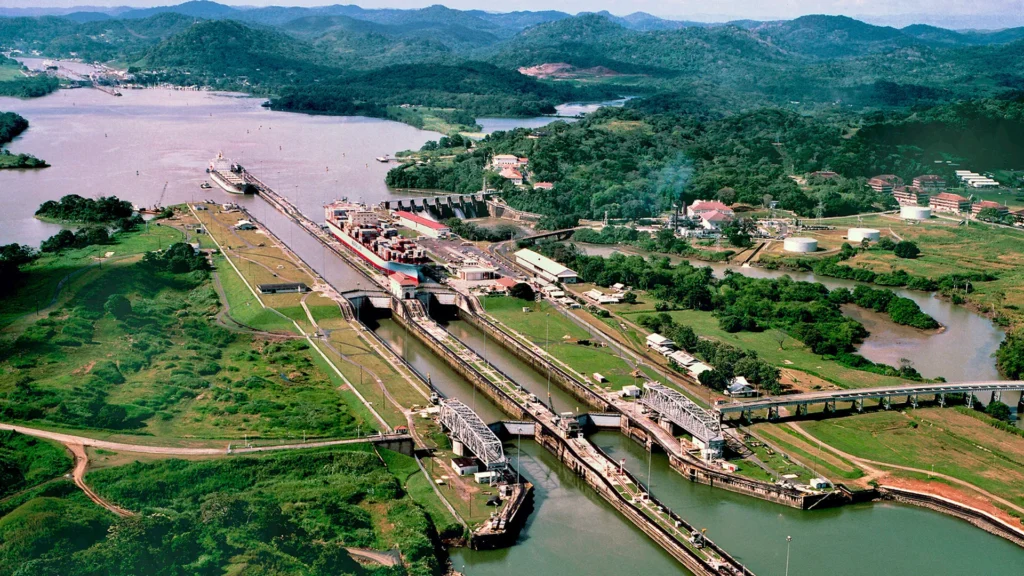
The Panama Canal is truly an engineering marvel. It uses a system of locks over a 50 mile area to connect the Atlantic and Pacific oceans. When it was constructed, the Panama Canal opened up global trade and travel by eliminating the need for ships to sail all the way around South America to move between the Atlantic and Pacific. Officially designated one of the “Seven Wonders of the Modern World,” the Panama Canal is also frequently referred to as the “Eighth Wonder of the World” due to its monumental engineering scale. For us as cruisers, transiting the Panama Canal was a bucket list item that we’ll never forget. It was also a huge step in our grand adventure to sail around the world.
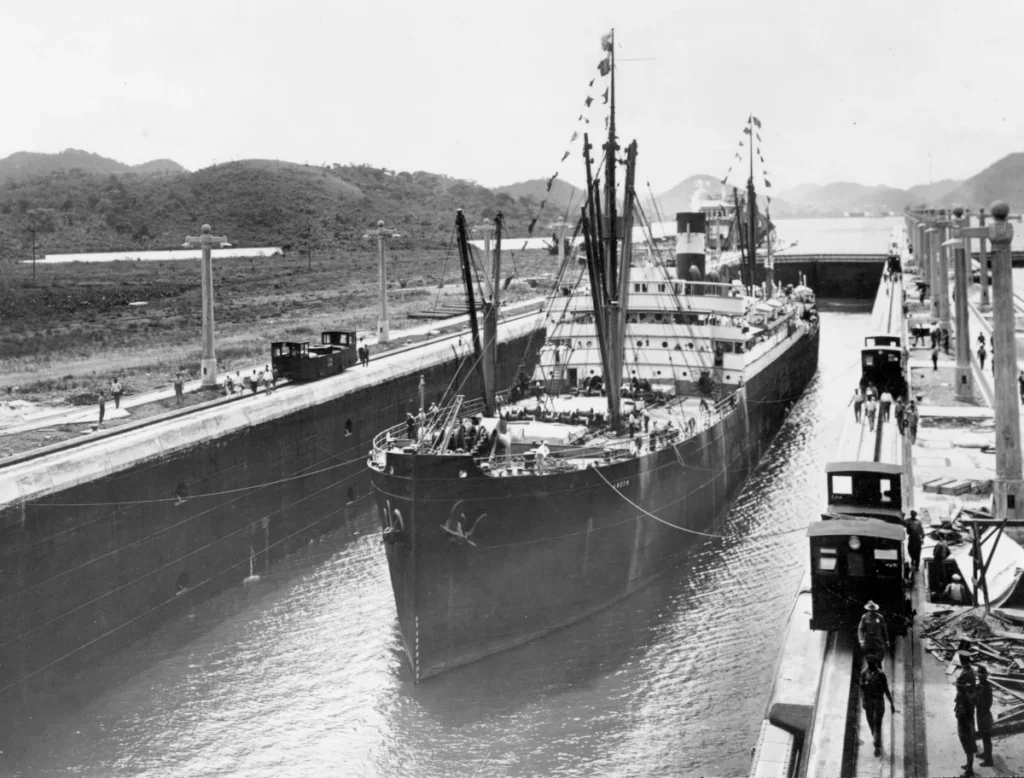
David McCullough in his book “The Path Between the Seas” wrote: “The creation of a water passage across Panama was one of the supreme human achievements of all time, the culmination of a heroic dream of over four hundred years and of more than twenty years of phenomenal effort and sacrifice. The fifty miles between the oceans were among the hardest ever won by human effort and ingenuity, and no statistics on tonnage or tolls can begin to convey the grandeur of what was accomplished. Primarily the canal is an expression of that old and noble desire to bridge the divide, to bring people together. It is a work of civilization.”
Preparing for our Panama Canal Transit
To make our lives easier, we opted to hire an agent to help us file the paperwork for our transit, and to ensure we had everything we needed to physically move our boat through the Canal. In order to reserve your transit date, you have to provide detailed boat measurements and crew information, fill out a LOT of paperwork, and pay the necessary fees. Since it was just Steven and I, we chose to hire four professional line handlers so Steven could pilot the boat and I was free to document the whole experience and fill in where needed. As part of hiring the line handlers, we had to provide them with three hot meals over the two days they were onboard, and provide places for them to sleep. We spent the day before the transit preparing sleeping areas onboard and readying the meals so we just had to warm them up.
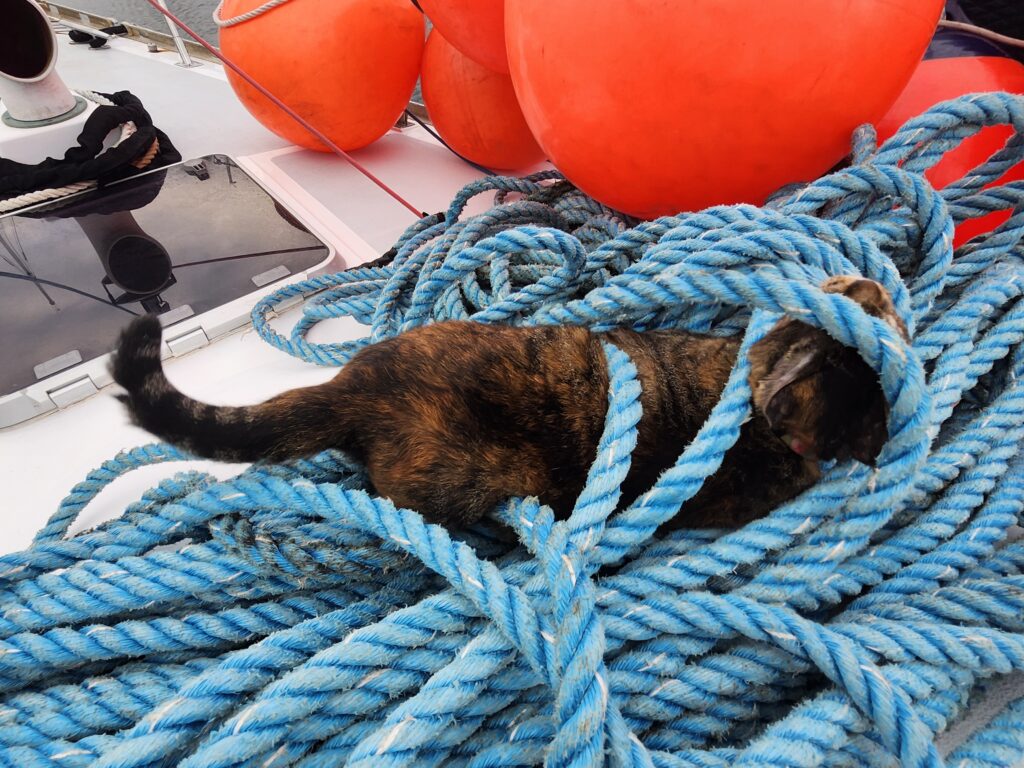
We also chose to rent the lines and fenders required for the transit, because we had to have four 125 foot, one inch lines. The day before our transit, the lines and fenders were delivered to our boat (and were thoroughly inspected by Lonna). While we had everything as ready as we could, trying to sleep that night was like trying to go to sleep as a kid the night before Christmas!
Transit Day One – Gatún Locks
We had an afternoon slot for our transit. Smaller recreational vessels like us are often rafted together 2 or 3 boats wide when going through the locks. As we were preparing, we found out we would be rafting up with our “next door neighbor” in Shelter Bay Marina! The crew of Panui was going through the Canal and then heading to the Galapagos, before crossing to French Polynesia. You can meet the Panui crew and watch their videos on their YouTube channel: https://www.youtube.com/@ThePanuiLog.
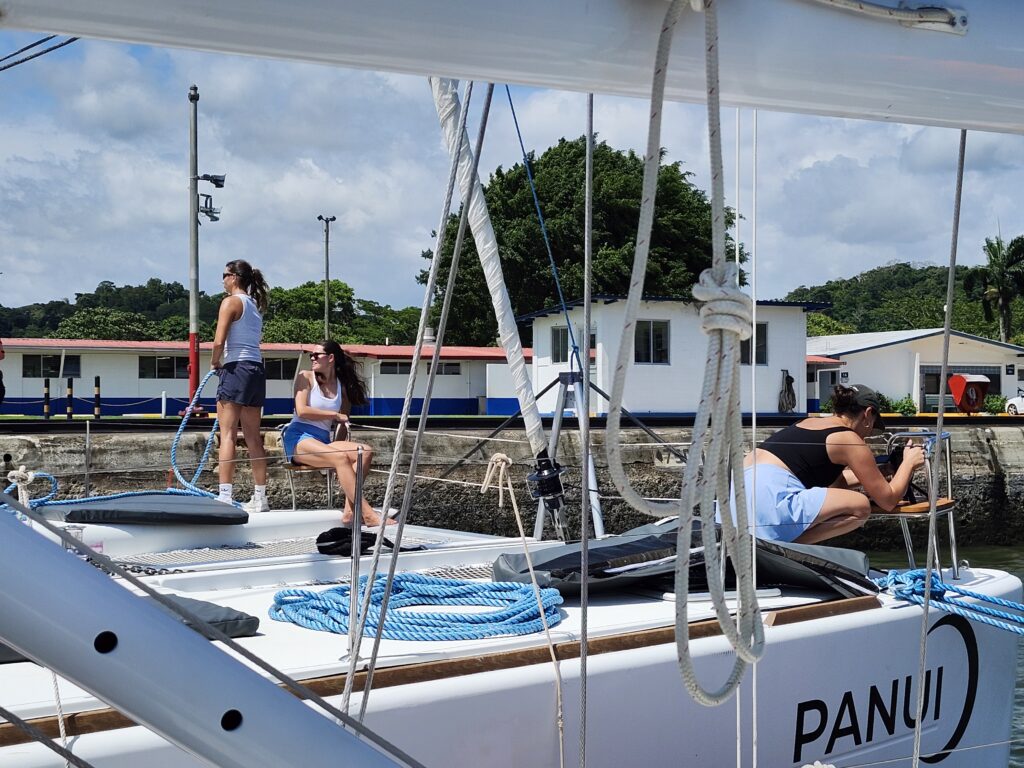
Our line handlers showed up that afternoon and promptly got the lines and fenders ready. They also helped us cover our solar panels for protection from incoming messenger lines, which have weighted monkeyfist knots on the end to make them easier to throw. Before we knew it, we were leaving Shelter Bay Marina. We held station in “The Flats” just outside Shelter Bay to wait for our Panama Canal advisor to be shuttled out to us. It was crazy to watch the pilot boat pull up alongside us and see the advisor hop down from their deck onto ours. But, everything went smoothly, and with our advisor onboard we headed for the Canal entrance.
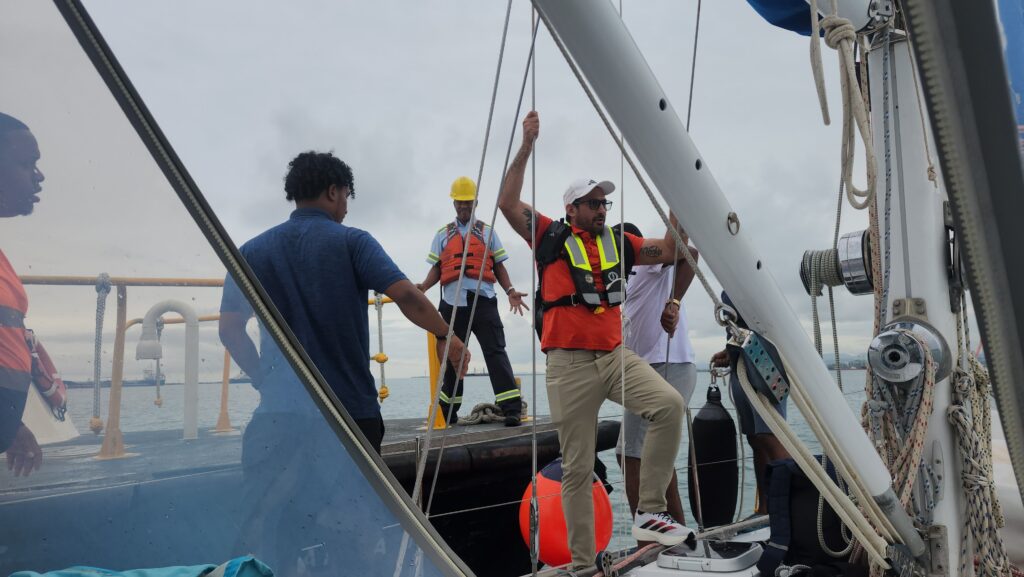
The level of logistics and coordination required to keep traffic moving in the Canal was staggering. Our advisor was in constant contact with the advisor on Panui, and the Canal Authority. We had to wait for our assigned tanker ship, Torm Dagmar, to come through the breakwater, and pass us. Then Panui pulled in behind them, and we followed Panui. As we approached the first set of locks, we pulled up alongside Panui and our crew and the advisors got our boats rafted together with fenders in between for protection.
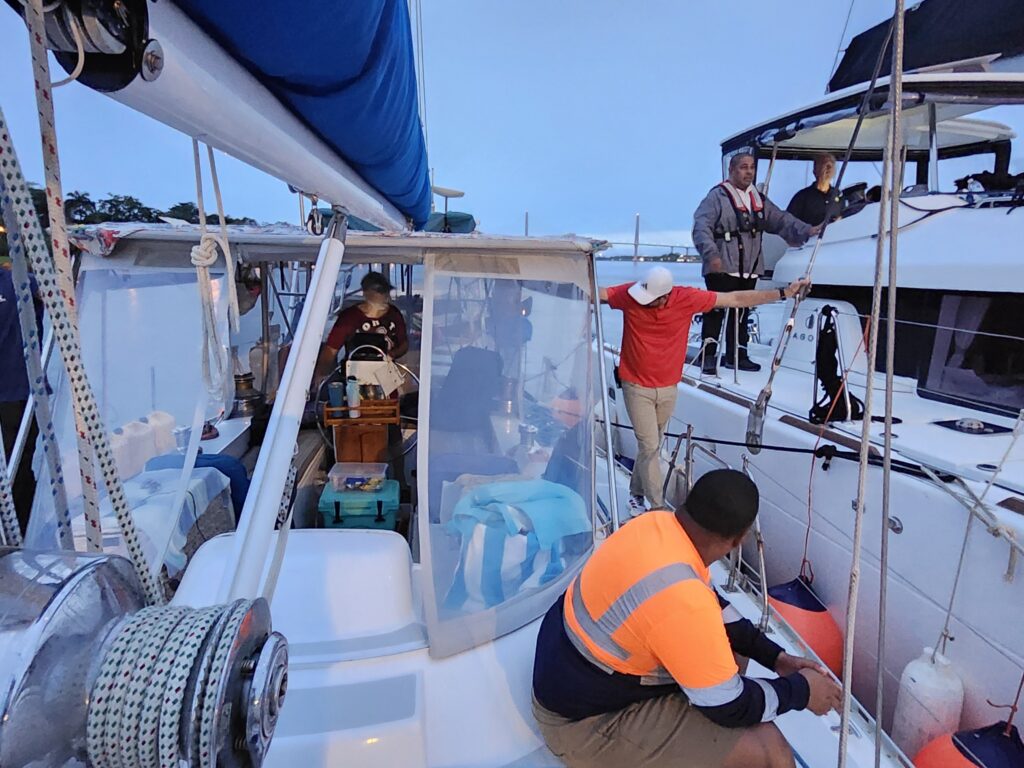
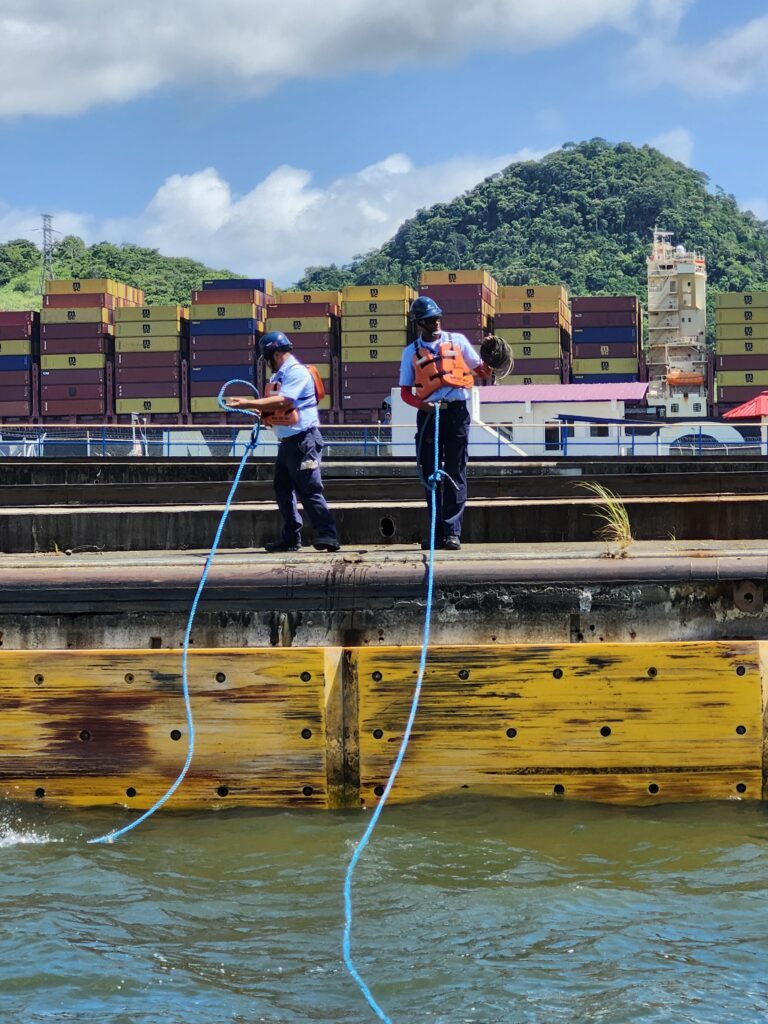
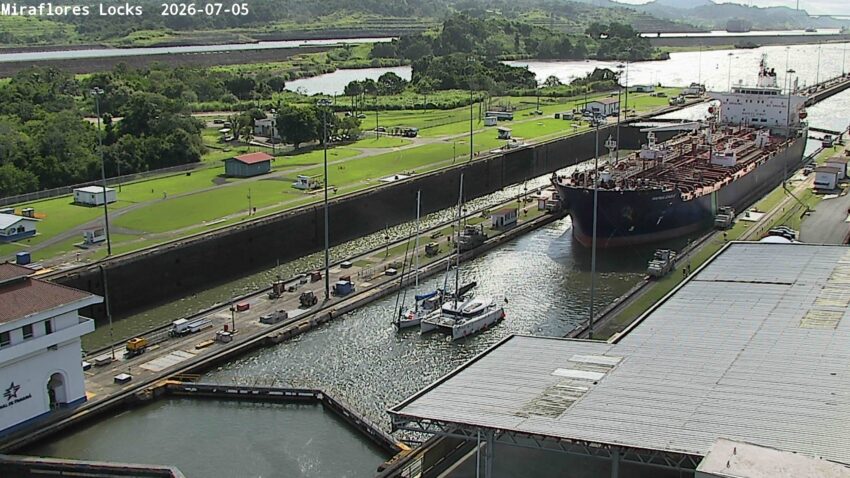
Once the Torm Dagmar had entered the first of the three Gatún Locks and was secured, it was our turn. The Canal workers threw their messenger lines to the line handlers, who then attached our rented lines. The Canal Workers hauled our lines back to attach to the cleats of the lock to hold us in place as the water rushes into the locks. Towering above us at the front of the lock was the Torm Dagmar, a 183 meter long, 32 meter wide oil/gas tanker sailing under the flag of Singapore. It felt surreal to be so close to such a massive ship, rafted up to a catamaran, knowing that soon millions of gallons of water would be flooding into the lock and raising us all above sea level.
We watched with bated breath as the giant lock gates closed behind us. As they closed, we felt this chapter of our Caribbean life come to a close as well. Not goodbye forever – just goodbye for now. Years of adventures, wonderful memories, and friendships that felt like family, all rushing back at once. Our hearts were full, and we were excited for the adventures to come.
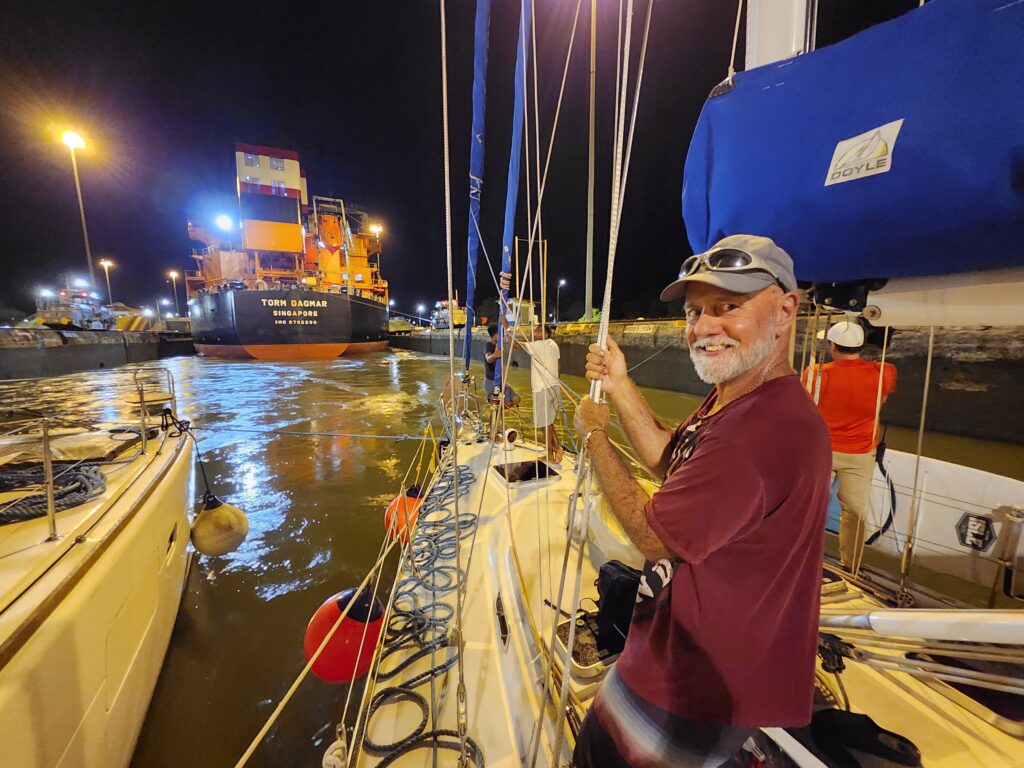
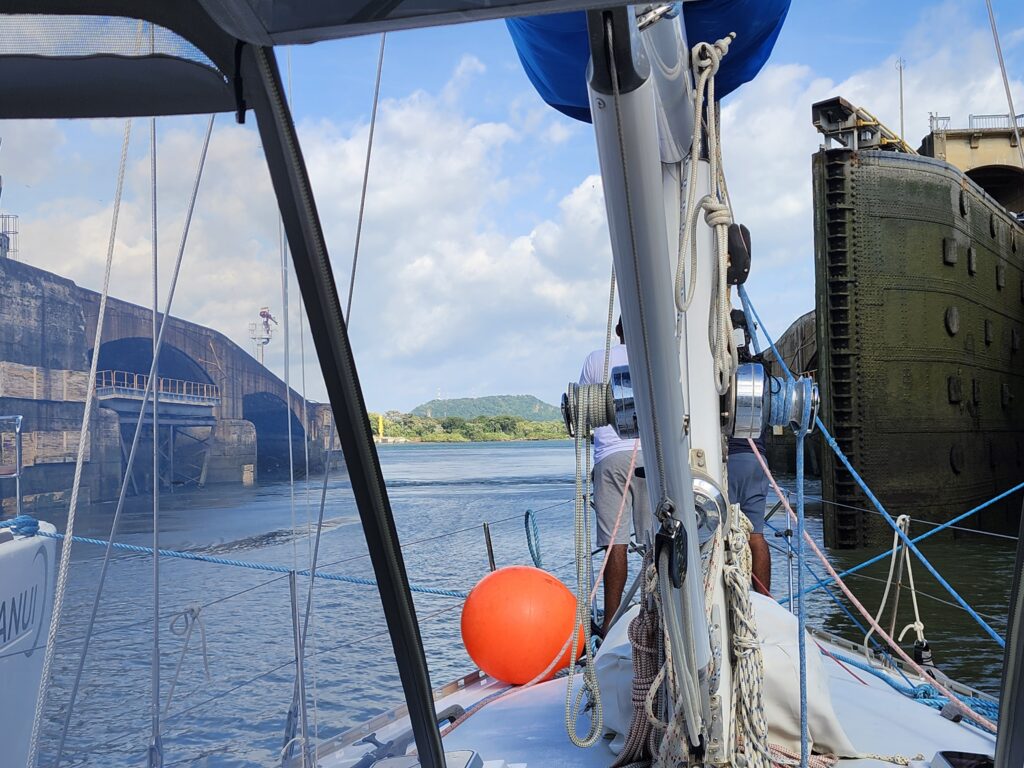
As the lock began to fill, you could see the water start to swirl around in little whirlpools. It takes 26.7 million gallons of water to flood each of the Gatún locks, and a gauge painted on the side wall really gave us a sense of just how fast the lock filled up. The line handlers kept our end of the lines pulled in as the water level rose, and the huge fenders protected us from bumping into the walls of the locks. Once the lock was full, the front gate slowly opened and the mules moved the tanker ship into the next lock, then we followed.
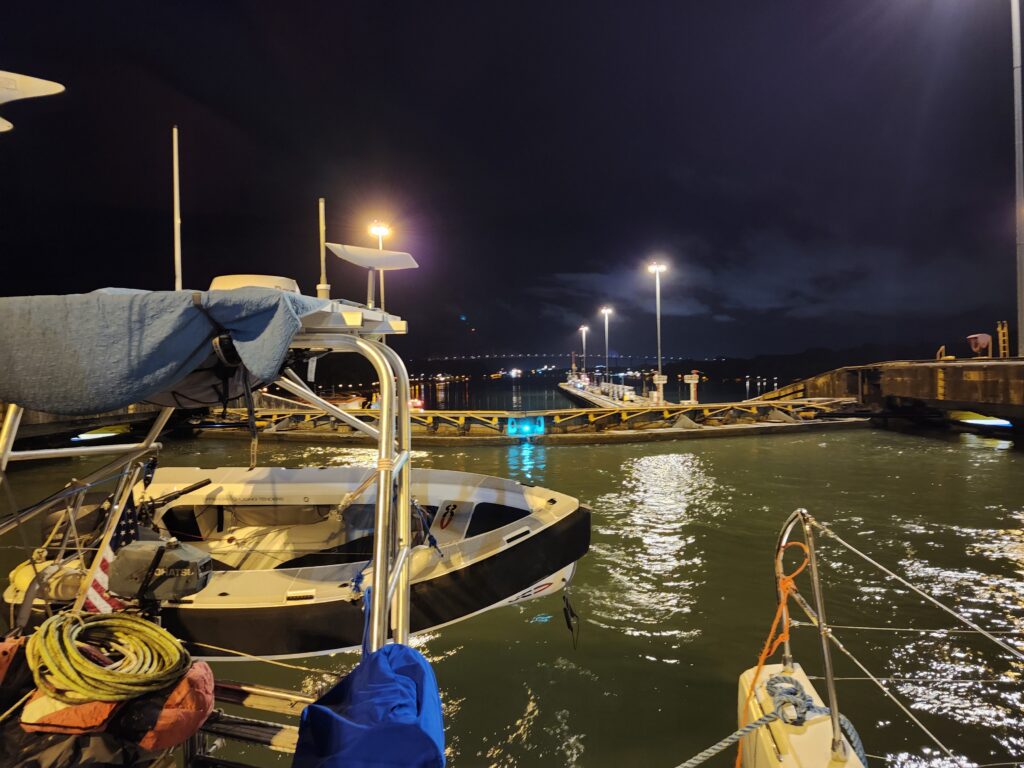
After the third lock gate opened, we were 85 feet above sea level in Gatún Lake! I can tell you it’s a bizarre sight to look back at the first lock and see only the top of a huge ship that is still at sea level. We untied from Panui and we headed for our mooring for the night. The line handlers got us tied up to the mooring, we ate a very late dinner and then we all crashed hard for the night, with most of the guys opting to sleep in the cockpit.
Transit Day Two – Pedro Miguel and Miraflores Locks
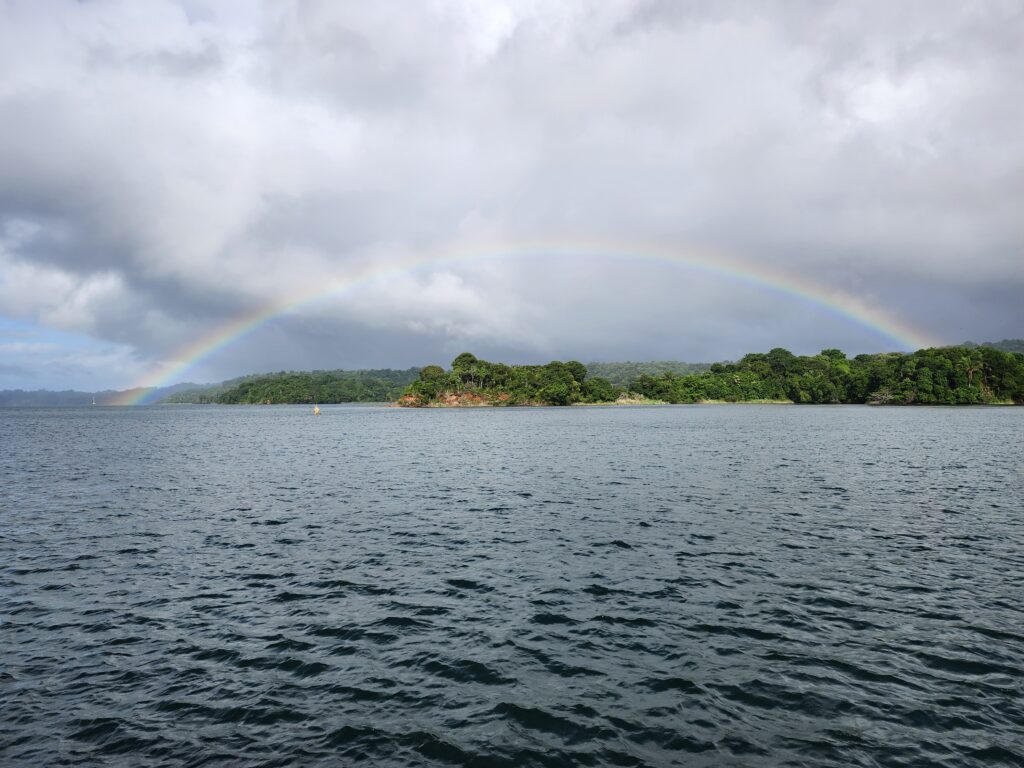
The start of day two was motoring across Gatún Lake. Our advisor was brought out to us at 9am, and we started across the lake in a misty rain. Once the rain cleared, the scenery was stunning – calm waters, blue skies, and lush green jungle islands. As we crossed the lake, giant cargo ships passed on their way to the Atlantic locks, and some were anchored among the islands waiting for their turn to complete their transit.
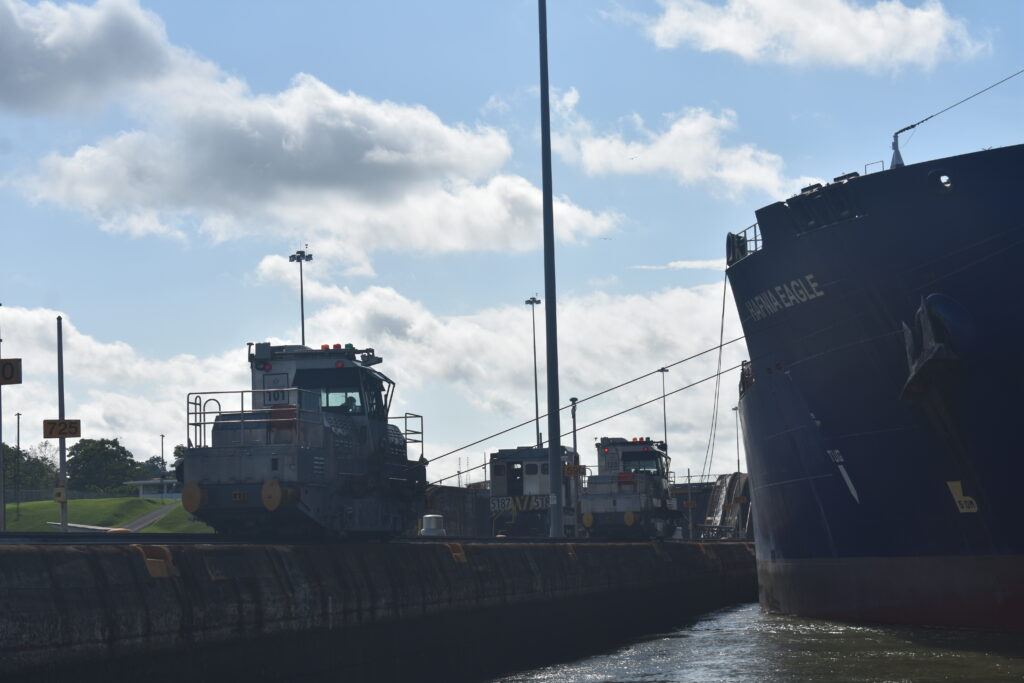
We reached the Pedro Miguel Lock in the early afternoon and rafted up with Panui again. This time, since we were being lowered to sea level, we would be in front of the massive ship we were sharing the locks with. Our assigned ship this time was the Hafina Eagle, a 183 meter long oil/chemical tanker flagged in Singapore. Imagine the nervous energy on our boats: we were tied to the walls of the lock, the lock gate was closed in front of us, and a huge tanker ship started coming up on our stern. It was a nail-biter moment for sure. But, the mule operators and line handlers are trained professionals after all, so we made it through the lock without incident.
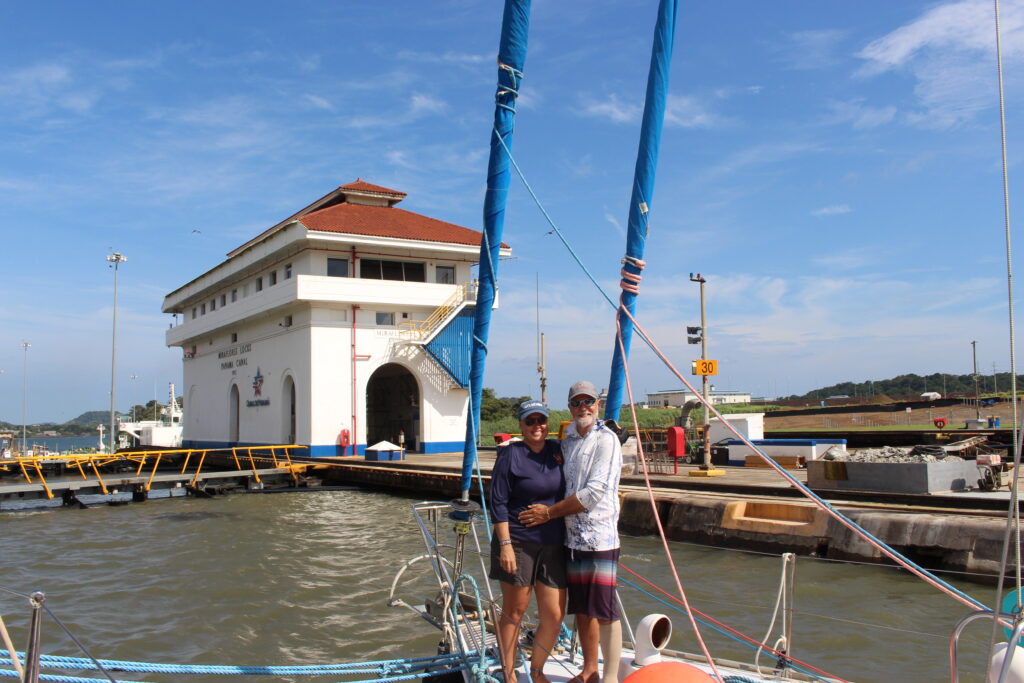
From there we motored across the small Miraflores Lake into the first of the Miraflores locks. These ones were especially fun! The Panama Canal Authority has a visitor’s center at Miraflores which has a viewing platform where you can watch ships transiting the Canal. They even have an IMAX Theater to watch a 3D movie about the Panama Canal history and operations narrated by Morgan Freeman. There was an announcer on the viewing platform narrating what was happening with our boats, and welcoming us to the Pacific when we passed through the last lock.
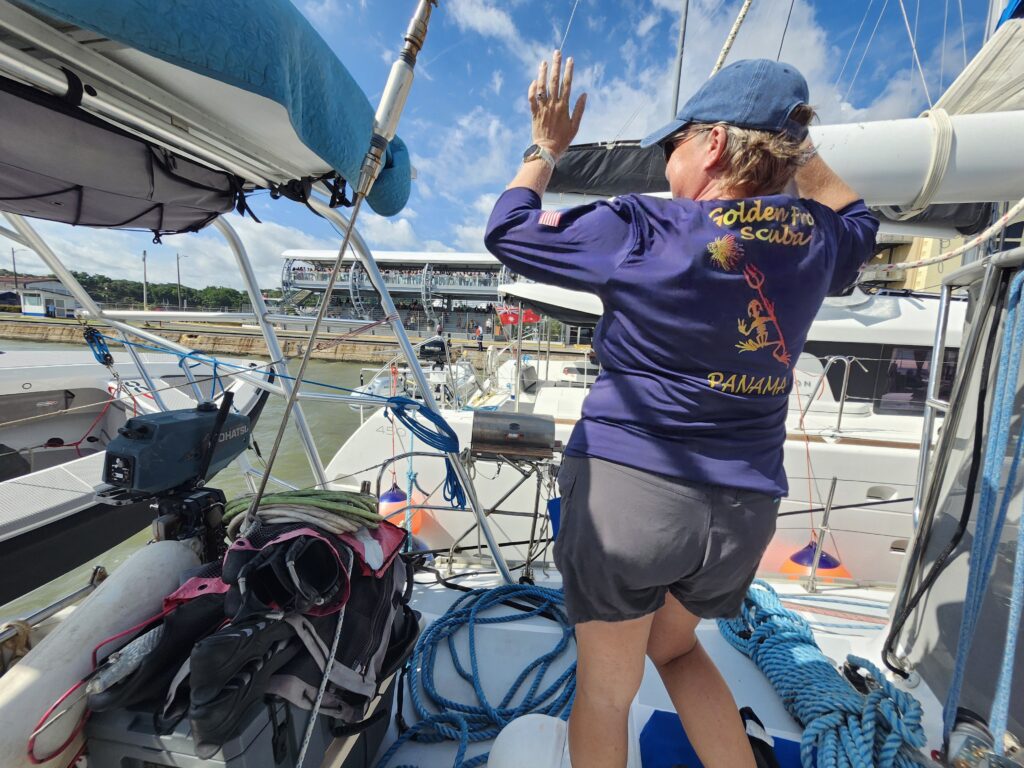
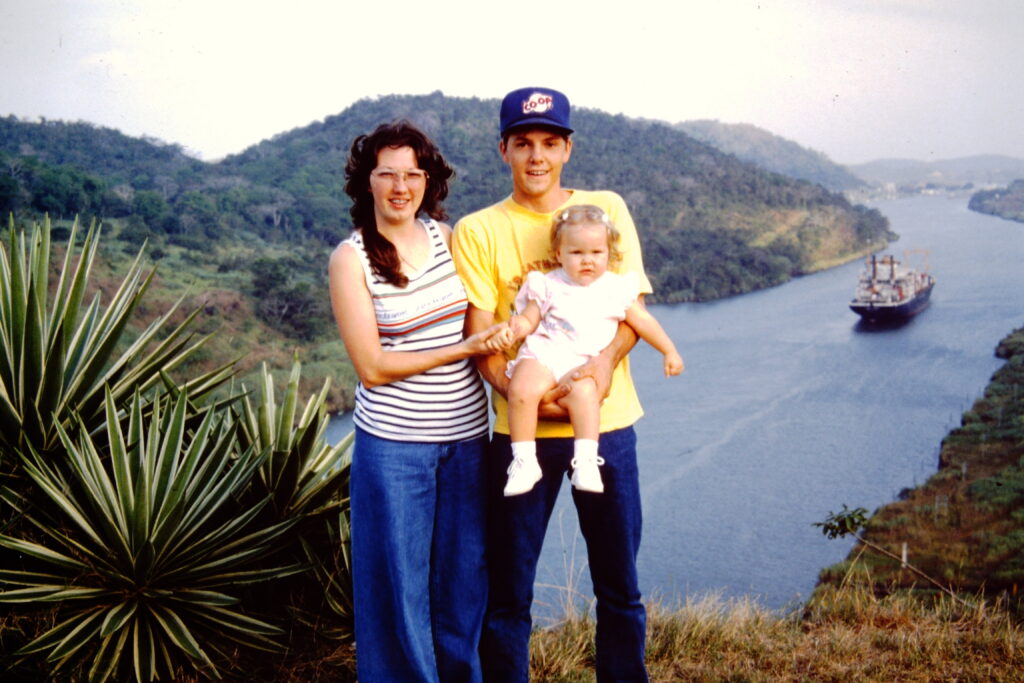
For me personally, going through the Miraflores Locks was especially poignant. When I was just a toddler, we lived in Panama and I have pictures with my parents and grandparents in front of the Miraflores Locks. Back then, I liked to wave at the sailors as they came through the Canal and see them wave back. Now, not only had I piloted our boat through one of the locks, but I got to BE the sailor waving at the observers as we went through the Miraflores Lock.
We Made it to the Pacific Ocean!
The excitement of finally reaching the Pacific after years of planning was indescribable. With Everlon in the Pacific, we have opened up a whole new world of cruising grounds and endless sailing possibilities. We got into La Playita Marina around 5pm, and promptly went out to dinner to celebrate making the crossing. After some fun cocktails and delicious seafood, we went back to the boat and slept for the next 12 hours!
So, what’s next? The general plan for the next year is to spend some time on the Pacific side of Panama, then sail onto Costa Rica, El Salvador, and finally Mexico. We want to spend some time cruising Mexico, and hopefully get back to the Sea of Cortez for a bit. Come late Spring, we plan to make our Pacific crossing to French Polynesia!
Stay tuned as we sail the Las Perlas Islands, explore Panama City, and discover what the Pacific side of Panama has to offer. Thanks for following us on our grand adventure!
-Jennie Ogden
Learn More About the Panama Canal
Between 13,000 and 14,000 ships from all over the world transit through the Panama Canal each year. With the help of approximately 9,000 workers, the Canal operates 24 hours a day, 365 days a year, offering transit service to ships from all nations. The history of the Panama Canal is fascinating, at least it is to geeks like us, as is the engineering that makes it work. If you want to learn more about the Panama Canal, visit the pancanal.com website.
One thought on “We Transited the Panama Canal!”
We enjoyed your narrative and are sooo proud of you both for this fabulous adventure.
Mark & Froma
Comments are closed.